Serving the sites that scheduled routes do not reach
Personnel transport, aerial work, technical support. Three areas shaped by one context: distant sites, demanding ground, and deadlines that are not open to negotiation.
Personnel transport
Crew change, without a break in the chain
Personnel rotation answers constraints that scheduled transport does not know: fixed groups, a rhythm set by the site rather than by the market, accompanying baggage and freight, and arrival strips that are often rudimentary.
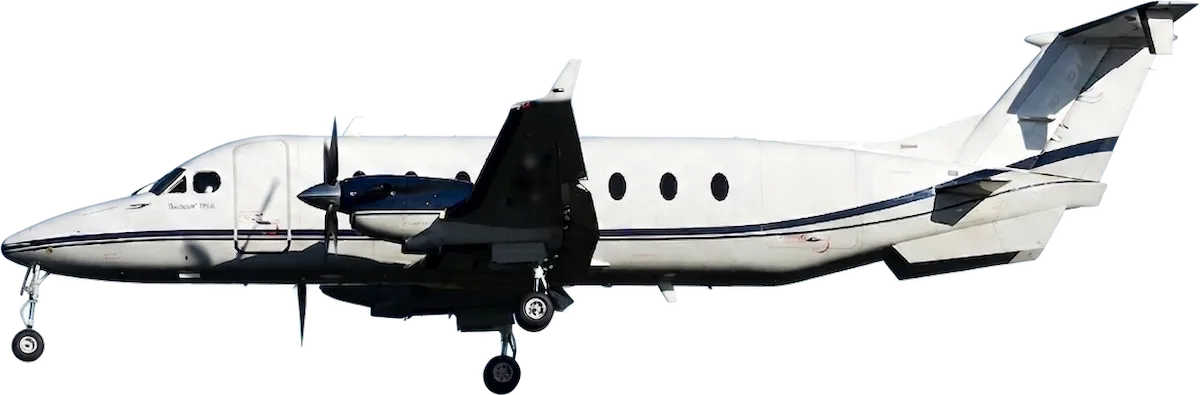
The Beechcraft 1900D answers that brief precisely. Nineteen seats, a stand-up cabin, useful hold volume, and runway requirements that open strips where a regional airliner cannot land.
The programme is built contract by contract: frequencies, timings, departure and destination points are sized with the client, then aligned with its own security and risk management procedures.
Aerial work
What cannot be planned for
Alongside scheduled rotations, an industrial site generates needs that nothing allows you to foresee: a management trip, a part to be flown in urgently, a medical evacuation, a reconnaissance overflight of ground that is hard to reach.
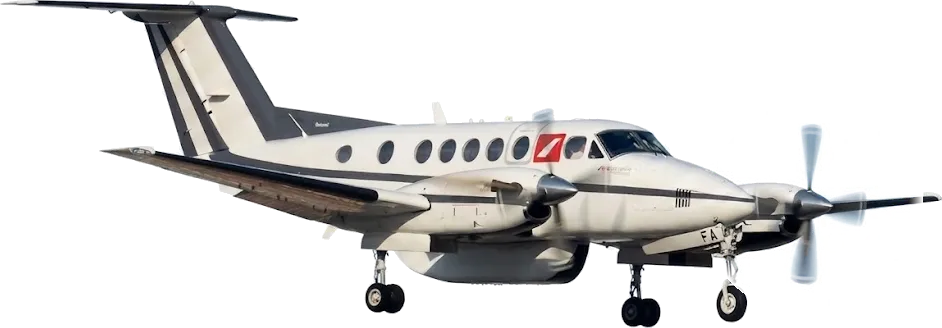
These missions turn on responsiveness and on the ability to land as close as possible to the need. The Beechcraft King Air 200 is sized for exactly that: small numbers, quick deployment, access to strips shorter still than those open to the 1900D.
Aerial work proper — observation, surveillance, operational support — follows the same logic. These are the trades practised in France by Aerosotravia, a shareholder in Akwaba Aviation Services, and whose methods the company takes up.
Technical support
Keeping an aircraft flying is not a support function
An aircraft grounded at a remote site does not merely stop a flight: it stops a crew change, and sometimes a worksite. Technical availability is therefore not a side matter — it is a condition of the service.
Akwaba Aviation Services treats continuing airworthiness management and maintenance support as part of the service delivered, not as peripheral subcontracting. For this it draws on the international industrial capabilities of the group to which it belongs, and on those of Chalair Aviation where the mission calls for them.
Implementation
How a service is built
No two service contracts are alike. The programme is built from the site, not from a catalogue.
- 01 — Needs analysis Sites to be served, numbers involved, rotation rhythm, runway and ground infrastructure constraints.
- 02 — Sizing Choice of aircraft type and frequency, construction of the flight programme and of fallback scenarios.
- 03 — Integration Alignment with the client's own security, risk management and reporting procedures.
- 04 — Operation A firm programme, a named point of contact, rotation monitoring and handling of disruption.
Contact
Tenders, supplier qualification, applications
For any enquiry regarding a live tender, supplier qualification or an application, please write to us.
Lot 21 Îlot 1 Section SV, Parcelle 38
Riviera Palmeraie Triangle
Cocody, Abidjan, Côte d'Ivoire contact@aas.ci